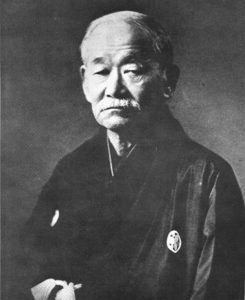
In the late 1890’s Kanō’s experiment in training Chinese students met with so much success that the program expanded beyond the capacity of the large house he had rented at Ushigome Nishigoken-chō. Starting in 1896 with 13 Chinese students urged on him by Prince Saionji Kinmochi (1849-1940), his long term acquaintance and then Foreign Minister, after a couple of years of experimentation, Kanō developed then continued to refine a preparatory school approach: the Chinese students spent a year learning Japanese and the basic skills to enable them to comprehend subjects at extended, regular technical school and university programs taught in Japanese that they might attend if successful. The latter programs typically extended for three or four years. In all Kanō inducted 7192 Chinese students into what eventually he named the Kōbun Gakuin (Chinese; Hóngwén xuéyuàn, often cited in English as the Hongwen Academy).
[See a longer explanation of its program here. Note that it includes a discussion of the pioneering work of the Kōbun Gakuin staff in developing an organized, standardized Japanese language instruction pedagogy, the first of its kind anywhere]:
https://kanochronicles.com/2020/08/30/the-kano-chronicles-kano-and-the-kobun-gakuin
The goal:
modernizing Chinese education
Some 3818 Chinese graduated and most (and even some of the drop outs) entered a range of advanced university programs, notably including Waseda University and even Kanō’s own Tokyo Higher Normal School, the premier teachers’ college for the Empire. For at its core, the program was primarily to build a strong, Chinese teacher cadre to modernize Chinese education, and the program graduates were obligated to serve in education positions for some years after returning to China.
Who paid for all this?
The Kōbun Gakuin preparatory program was entirely funded by the Q’ing Chinese government, paid by agreement in Chinese solid silver ingots called tael. A single tael is about 40 grams (1.3 ounces) of high grade silver, and they were minted in multiple tael weights (1, 5, 10, 100 etc). When paid out for this program, the silver was credited against the massive war reparations owed by the Chinese to Japan as part of the peace agreement for the Sino-Japanese War (1894-1895).
Why Japan? Why Kanō?
It might seem strange for the Chinese to put so much trust in a Japanese program only scant years after the disastrous Sino-Japanese War, but both governments agreed that Chinese education must be modernized to help it withstand encroachment from Western powers and that Japan was in a unique position to help. Not only was Japan closer than Western alternatives, it was cheaper, and the cultural differences not as pronounced. In turn, Kanō shihan was in a unique position within the Japanese education system and the Chinese education effort that he became so personally, intimately entwined with the program to the point that he was awarded a high Q’ing Imperial court award by the Empress Cixi in recognition of his valuable service in modernizing Chinese education. One key source described him as the coordinator of the entire massive effort which resulted in tens of thousands beyond the 7000 Kōbun Gakuin students studying in Japan and scores of Q’ing Dynasty officials visiting to observe the system, often met by Kanō himself, who took the opportunity to introduce untold numbers of them to jūdō, a factor in later developments in China.
While other countries’ war reparations debt from the later Boxer Rebellion (1899-1901) were eventually forgiven by other combatants, including the United States and Britain, the Japanese simply added their Boxer Rebellion reparations due to the Sino-Japanese War reparations already due and being paid out to fund the overseas study program in Japan. Stacks of silver were shipped to the Chinese legation in Tokyo and distributed to the Chinese students for their living expenses and to the Japanese government for Kanō Jigorō (or at least to his school’s administrative staff).
Where was the land?
And just how many Fujimi-chō are there in Tokyo?
Kanō arranged for the purchase of several parcels of adjoining land in the neighborhood of the then Koishikawa ku (ward) called Sakashita-chō. (The attached presentation includes detailed maps.) That small neighborhood was adjacent to a hill then called Fujimi-chō (“Fuji view town”, as one of several high ground areas of Tokyo were and are still called today; this is particularly confusing since from 1886-1889 the Kodokan was based in another Fujimi-chō on the estate of Kanō patron and arch conservative Shinagawa Yajirō.
See the tale of that other Fujimi-chō dōjō here):
https://kanochronicles.com/2020/03/24/the-kano-chronicles-count-shinagawa-yajiro-and-the-fujimicho-kodokan/
Sakashita-chō, meaning “the neighborhood below the hill” referred to the small, adjacent neighborhood’s position below the crest of the hill then called Fujimi-chō. Kanō eventually had three classroom and administrative buildings erected for the Kōbun Gakuin, and at its peak they accommodated more than 1300 students at once plus instructors and support staff. Those hundreds of students drudged up the steep Kaiunzaka slope daily, and Kanō apparently named it “Fortune Opening Hill” to encourage the Chinese to focus on the opportunities afforded them by this education. As was his wont, Kanō proselytized physical education in general and jūdō specifically to his new students and had a small dōjō built for them; the Ushigome bundōjō or branch dōjō promoted 33 Chinese students to shodan 1st degree black belt before the school moved to Kaiunzaka in 1903, and untold others likely practiced there, too.
But by 1909, the program and studying in Japan in general had fallen out of favor with Chinese students for reasons we’ll explore separately later, enrollment dropped precipitously, and the Kōbun Gakuin was closed. But by then Kanō had built a large house on the estate and arranged his life around it. The Kodokan had expanded dramatically over the years, and after some 27 years of managing it personally, at 47 years of age Kanō arranged for it to be made a foundation in 1909. Its first managing directors were Kanō, who also served as the Foundation’s first head (kanchō), and his close friends Inukai Tsuyoshi (1855-1932), an avid Japanese archer and future Prime Minister when he was assassinated in 1932, and a graduate of his Kanō juku private school. On the steep slope below Kanō’s house and the defunct Kōbun Gakuin, the new Kodokan Foundation headquarters and an adjoining 107-mat dōjō were built, where they remained until 1933.
After apparently leasing the land for several years, Kanō eventually bought the entire estate for his private use. At its largest it covered more than 3000 tsubo, a traditional Japanese land measurement, well over 100,000 square feet or about 9300 square meters. But he began to parcel it out, first to the Kodokan, next to close associates including Yamashita Yoshitsugu, who built his home there, then in sales that continued for years.
Why that neighborhood?
Kaiunzaka was only 1.5km (~1 mile) from Kanō’s primary official position at the Tokyo Higher Normal School as its principal and about 3km from the older Shimotomizaka Kodokan dōjō which was redesignated as Daiichi Dōjō, the Number One dōjō. Also, around 1900, the area of north Koishikawa-ku was still sparsely populated with few roads, only recently absorbed into Tokyo proper, and finding such a large parcel of land was still possible. There Kanō could build a large home with a large garden and stable his horses; he kept up to 5 at once. Later new roads nearby supported a rapid increase in the local population as Tokyo expanded. Inside the city, most available large areas had been the Edo era residences of high ranking daimyō, the retainers of the shogun, which reverted to Meiji government control after the 1867 Restoration.
Indeed, the Ōtsuka area occupied by the Tokyo Higher Normal School had been such an Edo daimyō residential compound that reverted to the Meiji government after the Meiji Restoration. The school eventually evolved to become Tsukuba University’s Tokyo Campus (3-29-1 Otsuka, Bunkyo-ku, Tokyo), joined with other schools to form the new Tsukuba University; Kanō’s role in its development is memorialized by a statue of him in the Senshunen Park adjacent to the university. The statue itself is a duplicate of his statue outside the Kodokan.
http://soutairoku.com/07_douzou/06_ka/kanou_zigorou.html
I hope you enjoy the presentation.
As usual, please sign up at the link below to get notices of updates, and all constructive comments will be read and probably answered.
 The Kano Chronicles© 嘉納歴代©