Attached is an essay I recently wrote with Mr. George Rego of Florida regarding Kime no kata. フロリダのジョージ・レゴ氏と最近書いた講道館柔道の「極の形」に関するエッセイを添付します。
The “Form of Decision” is one way to translate the Japanese name, 極の形, which indicates that the kata focuses on decisive techniques, methods to finish engagements quickly and, if necessary, in a deadly fashion. 「決断の形」は、日本語名「極の形」を翻訳する方法の 1 つであり、この型が決定的なテクニック、つまり交戦を迅速に、必要に応じて致命的な方法で終了する方法に焦点を当てていることを示しています。
Kime no kata is unique in that Kanō Jigorō shihan (master) wrote that it is the heart of jūdō. But it is also arguably the oldest of the several formal Kodokan kata, drawing upon techniques from 2 koryū jūjutsu (“ancient schools” of hand to hand combat) nearly 200 years old when he and his senior students assembled a number techniques to create a “new” kata in the 1890s. Those schools in turn had adopted techniques from older schools, some documented to be as old as the 16th century. 極めの型は、嘉納治五郎師範が柔道の核心であると書いたという点でユニークです。しかし、それはまた、ほぼ200年前の2つの古流柔術流(「古代の格闘流派」)の技法を利用しており、1890年代に彼と上級の弟子たちがいくつかの技法を集めて「新しい」型を作ったもので、いくつかの講道館の正式な型の中ではおそらく最も古いものです。それらの流派は、16世紀にまで遡る古い流派の技法を採用していました。
What can today’s judoka (judo practitioner) learn from such after 500 years? Of what practical utility are such techniques today? 今日の柔道家は、500年後のそのようなものから何を学べるでしょうか?今日、そのような技法はどのような実用性があるのでしょうか?
Please take a look and let me know if you have questions or comments. This one is a bit of an experiment, so constructive comments welcome! There are more essays on a range of jūdō and martial arts topics here at www.kanochronicles.com ぜひご覧になって、質問やコメントがあればお知らせください。 柔道と武道のさまざまなトピックに関するエッセイは、こちらにあります。www.kanochronicles.com Please subscribe below to get email updates of new material.
In the late 1890’s Kanō’s experiment in training Chinese students met with so much success that the program expanded beyond the capacity of the large house he had rented at Ushigome Nishigoken-chō. Starting in 1896 with 13 Chinese students urged on him by Prince Saionji Kinmochi (1849-1940), his long term acquaintance and then Foreign Minister, after a couple of years of experimentation, Kanō developed then continued to refine a preparatory school approach: the Chinese students spent a year learning Japanese and the basic skills to enable them to comprehend subjects at extended, regular technical school and university programs taught in Japanese that they might attend if successful. The latter programs typically extended for three or four years. In all Kanō inducted 7192 Chinese students into what eventually he named the Kōbun Gakuin (Chinese; Hóngwén xuéyuàn, often cited in English as the Hongwen Academy). [See a longer explanation of its program here. Note that it includes a discussion of the pioneering work of the Kōbun Gakuin staff in developing an organized, standardized Japanese language instruction pedagogy, the first of its kind anywhere]: https://kanochronicles.com/2020/08/30/the-kano-chronicles-kano-and-the-kobun-gakuin
The goal: modernizing Chinese education
Some 3818 Chinese graduated and most (and even some of the drop outs) entered a range of advanced university programs, notably including Waseda University and even Kanō’s own Tokyo Higher Normal School, the premier teachers’ college for the Empire. For at its core, the program was primarily to build a strong, Chinese teacher cadre to modernize Chinese education, and the program graduates were obligated to serve in education positions for some years after returning to China.
Who paid for all this?
The Kōbun Gakuin preparatory program was entirely funded by the Q’ing Chinese government, paid by agreement in Chinese solid silver ingots called tael. A single tael is about 40 grams (1.3 ounces) of high grade silver, and they were minted in multiple tael weights (1, 5, 10, 100 etc). When paid out for this program, the silver was credited against the massive war reparations owed by the Chinese to Japan as part of the peace agreement for the Sino-Japanese War (1894-1895).
Why Japan? Why Kanō?
It might seem strange for the Chinese to put so much trust in a Japanese program only scant years after the disastrous Sino-Japanese War, but both governments agreed that Chinese education must be modernized to help it withstand encroachment from Western powers and that Japan was in a unique position to help. Not only was Japan closer than Western alternatives, it was cheaper, and the cultural differences not as pronounced. In turn, Kanō shihan was in a unique position within the Japanese education system and the Chinese education effort that he became so personally, intimately entwined with the program to the point that he was awarded a high Q’ing Imperial court award by the Empress Cixi in recognition of his valuable service in modernizing Chinese education. One key source described him as the coordinator of the entire massive effort which resulted in tens of thousands beyond the 7000 Kōbun Gakuin students studying in Japan and scores of Q’ing Dynasty officials visiting to observe the system, often met by Kanō himself, who took the opportunity to introduce untold numbers of them to jūdō, a factor in later developments in China.
While other countries’ war reparations debt from the later Boxer Rebellion (1899-1901) were eventually forgiven by other combatants, including the United States and Britain, the Japanese simply added their Boxer Rebellion reparations due to the Sino-Japanese War reparations already due and being paid out to fund the overseas study program in Japan. Stacks of silver were shipped to the Chinese legation in Tokyo and distributed to the Chinese students for their living expenses and to the Japanese government for Kanō Jigorō (or at least to his school’s administrative staff).
Where was the land? And just how many Fujimi-chō are there in Tokyo?
Kanō arranged for the purchase of several parcels of adjoining land in the neighborhood of the then Koishikawa ku (ward) called Sakashita-chō. (The attached presentation includes detailed maps.) That small neighborhood was adjacent to a hill then called Fujimi-chō (“Fuji view town”, as one of several high ground areas of Tokyo were and are still called today; this is particularly confusing since from 1886-1889 the Kodokan was based in another Fujimi-chō on the estate of Kanō patron and arch conservative Shinagawa Yajirō. See the tale of that other Fujimi-chō dōjō here): https://kanochronicles.com/2020/03/24/the-kano-chronicles-count-shinagawa-yajiro-and-the-fujimicho-kodokan/
Sakashita-chō, meaning “the neighborhood below the hill” referred to the small, adjacent neighborhood’s position below the crest of the hill then called Fujimi-chō. Kanō eventually had three classroom and administrative buildings erected for the Kōbun Gakuin, and at its peak they accommodated more than 1300 students at once plus instructors and support staff. Those hundreds of students drudged up the steep Kaiunzaka slope daily, and Kanō apparently named it “Fortune Opening Hill” to encourage the Chinese to focus on the opportunities afforded them by this education. As was his wont, Kanō proselytized physical education in general and jūdō specifically to his new students and had a small dōjō built for them; the Ushigome bundōjō or branch dōjō promoted 33 Chinese students to shodan 1st degree black belt before the school moved to Kaiunzaka in 1903, and untold others likely practiced there, too.
But by 1909, the program and studying in Japan in general had fallen out of favor with Chinese students for reasons we’ll explore separately later, enrollment dropped precipitously, and the Kōbun Gakuin was closed. But by then Kanō had built a large house on the estate and arranged his life around it. The Kodokan had expanded dramatically over the years, and after some 27 years of managing it personally, at 47 years of age Kanō arranged for it to be made a foundation in 1909. Its first managing directors were Kanō, who also served as the Foundation’s first head (kanchō), and his close friends Inukai Tsuyoshi (1855-1932), an avid Japanese archer and future Prime Minister when he was assassinated in 1932, and a graduate of his Kanō juku private school. On the steep slope below Kanō’s house and the defunct Kōbun Gakuin, the new Kodokan Foundation headquarters and an adjoining 107-mat dōjō were built, where they remained until 1933.
After apparently leasing the land for several years, Kanō eventually bought the entire estate for his private use. At its largest it covered more than 3000 tsubo, a traditional Japanese land measurement, well over 100,000 square feet or about 9300 square meters. But he began to parcel it out, first to the Kodokan, next to close associates including Yamashita Yoshitsugu, who built his home there, then in sales that continued for years.
Why that neighborhood?
Kaiunzaka was only 1.5km (~1 mile) from Kanō’s primary official position at the Tokyo Higher Normal School as its principal and about 3km from the older Shimotomizaka Kodokan dōjō which was redesignated as Daiichi Dōjō, the Number One dōjō. Also, around 1900, the area of north Koishikawa-ku was still sparsely populated with few roads, only recently absorbed into Tokyo proper, and finding such a large parcel of land was still possible. There Kanō could build a large home with a large garden and stable his horses; he kept up to 5 at once. Later new roads nearby supported a rapid increase in the local population as Tokyo expanded. Inside the city, most available large areas had been the Edo era residences of high ranking daimyō, the retainers of the shogun, which reverted to Meiji government control after the 1867 Restoration.
Indeed, the Ōtsuka area occupied by the Tokyo Higher Normal School had been such an Edo daimyō residential compound that reverted to the Meiji government after the Meiji Restoration.The school eventually evolved to become Tsukuba University’s Tokyo Campus (3-29-1 Otsuka, Bunkyo-ku, Tokyo), joined with other schools to form the new Tsukuba University; Kanō’s role in its development is memorialized by a statue of him in the Senshunen Park adjacent to the university. The statue itself is a duplicate of his statue outside the Kodokan. http://soutairoku.com/07_douzou/06_ka/kanou_zigorou.html
I hope you enjoy the presentation. As usual, please sign up at the link below to get notices of updates, and all constructive comments will be read and probably answered.
Kanō Jigorō’s calligraphies are well documented. He was fairly prolific, writing various sayings he adopted for jūdō instruction, usually in a very distinct hand with a block-type script.
Recently I found a heretofore a calligraphy unmentioned by Kanō scholars and archivists in an obscure book published in the 1920s. I found it interesting enough to research it a bit and translate it from the original Chinese over two millennia old.
While Kanō wrote top to bottom / right to left, the original text can be grouped left to right top to bottom as:
道雖近 不行不至 事雖小 不為不成
Even if the Way is near, not going – you cannot arrive;
even small matters, not doing – remain incomplete.
A possible alternate translation:
Although the Dào is near, it cannot be traveled without traveling; although a matter is small, it cannot be done without doing.
My interpretation is that Kanō creates an admonition to action – to move, to do, to practice in pursuit of self-cultivation. Don’t just consider the Way, move yourself to travel it despite the hardships involved (the chapter cites many hardships).
The text is an extract from the writings of Xunzi 荀子 (JA: Junshi, 3rd century BCE), one of the most famous Confucian philosophers. The specific context is the book 脩身 Xiūshēn “Self Cultivation”, which emphasizes that a “gentleman” (i.e., a well-educated, moral, upstanding person) should act according to 礼 rei (CH: li).
“Wing-tsit Chan explains that 礼 rei / li originally meant “a religious sacrifice, but has come to mean ceremony, ritual, decorum, rules of propriety, good form, good custom, etc., and has even been equated with natural law.”[1] (English Wiki: “Li” Confucianism )
In the middle of the text for Chapter 8, Xunzi cites the Dàoist binaries 「堅白」、「同異」and「有厚無厚」.
「堅白」Jiān bai – hard / white.
「同異」Tóng yì – Alike / unalike
「有厚無厚」Yǒu hòu wú hòu – Profound / superficial
Jiān bai hard / white is a strange couple, one that is not the normal statement of opposites (e.g., Yin / Yang, hot / cold, hard / soft). It is a couple used in earlier Mohist, Dàoist (including Zhuangzi) and even ancient School of Names texts to both introduce sophistry and to criticize sophists who would argue what is hardness, what is white? What is sameness and not sameness? But it apparently over the ages it eventually became a sort of shorthand for “Speaking directly and clearly / speaking to obfuscate” or wasting time and effort in sophistry.
Subscribe above with your email to get automatic updates of new material! Comments welcome! See entry block at the end of Notes.
Xunzi 荀子 (third century BCE) was a Confucian philosopher, sometimes reckoned as the third of the three great classical Confucians (after Confucius and Mencius). For most of imperial Chinese history, however, Xunzi was a bête noire who was typically cited as an example of a Confucian who went astray by rejecting Mencian convictions. Only in the last few decades has Xunzi been widely recognized as one of China’s greatest thinkers.
While Xunzi is not included in the normal, basic Chinese classics education that Kanō began at 6 or 7 years of age, which focuses on the 四書五経 Shisho Gokyō The Four Books and the Five Classics, he later studied at what is today Nishogakusha University, at the time a juku private school focused on ancient Chinese texts. (The Five Classics: Book of Odes, Book of Documents, Book of Changes, Book of Rites, and the Spring and Autumn Annals. The Four Books: the Doctrine of the Mean, the Great Learning, Mencius, and the Analects, the core books of the Confucian canon.)
As always, I use the fabulous Chinese Text Project http://www.ctext.org to research the ancient texts. “The Chinese Text Project is an online open-access digital library that makes pre-modern Chinese texts available to readers and researchers all around the world. The site attempts to make use of the digital medium to explore new ways of interacting with these texts that are not possible in print. With over thirty thousand titles and more than five billion characters, the Chinese Text Project is also the largest database of pre-modern Chinese texts in existence.”
On this calligraphy, Kanō shihan’s pen name is written by the three small vertical characters on the far left of the scroll, 進乎斎 followed below by two seals stamped in black ink (this may be a black and white photo with the original seals in red, the normal convention).
「進乎斎」Shinkosai, used in this calligraphy, was Kanō’s pen name in his 60’s, namely 1920 to 1930. 進乎斎 Shinkosai is thought to be a reference to certain writings of 莊子 Zhūangzi (Chinese for “Master Zhūang”, Japanese: Sōshi), one of the most influential philosophers of the Dào (Chinese: Dào 道 , Japanese: Dō, often earlier in the West as Tao), “The Way”, active during China’s Warring States period [350 BC-250 BC]. Shinko 進乎 (progress) appears in two noted passages of his most important text, the Zhūangzi, one of the two foundational Daoist texts along with the Dào De Jing. The sai 斎 of Shinkosai is an old Japanese variant of the traditional Chinese character 齋 zhāi (simplified today as 斋) which means “to fast” or “study”, so Shinkosai means something like “progress through fasting”. In this sense “fasting” means the Dàoist discipline of focusing the spirit to learn the Way and the true nature of things by isolating the spirit from the distractions of perceptions of the physical world (represented by “hearing”), emotions and thought. (Handler S, 2022 communication).
The Zhūangzhi chapter thought to be the source of Kanō’s pen name is the 2500 year old Dàoist tale of a master butcher. Lord Wen-hui, captivated by the evident skill of the Butcher Ding (in some translations Ting), asked how Ding can so effortlessly butcher entire oxen.
Cook Ding replied that he only cared about the Way, which exceeded skill. But when he first began butchering oxen, all he could see was the ox. After three years he no longer saw the whole ox. Finally, he said, he proceeded by spirit alone and didn’t even look with his eyes. His skill was so effortless and insight so powerful that he never even had to sharpen his blade, using the same one for years, and the ox carcasses simply fell apart under his blade. Perception and understanding had stopped and he had proceeded to the point that his spirit moved where it wanted (Watson B, 2013), meaning it was in accordance with the Way of the Dao.
What I think Kanō meant by adopting such a pen name in his 60’s was that he was proclaiming he, too, had progressed beyond mere perception and thought and had learned to only seek the Way through his spirit. Even though Kanō paid tribute to Japanese tradition and nearly 2500 year old Dàoist thought by his choice of a pen name rooted in an ancient text, for Kanō the Way he sought to follow was not the Way of the Dào, but rather the Way of jūdō, which means “The Way of Flexibility.” Kanō defined that Way in part through the phrases 精力善用自他共栄 Seiryoku Zenyō Jita Kyōei, Best Use of Energy / Mutual Benefit, the modern jūdō philosophies he derived from the late 19th century writings of Herbert Spencer and other English Utilitarian philosophers he studied at the then new Tokyo University in his youth. (Gatling L, 2021)
Kanō was saying that he no longer needed perception of the physical world (hearing or seeing) or thought (knowledge or emotion) to employ the techniques that initially guided his pursuit of his Way, but now sought to proceed through the understanding and learning of his spirit alone. Having practiced for so many years, he could proceed simply by keeping his spirit focused on the Way. Without conscious thought he could accomplish the smaller things addressed by his perceptions and mind, honed by years of constant training and attentive practice of the Way of jūdō. He no longer saw people and situations, but looked beyond them to see the Way. In this he equated his understanding and skills with that of the estimable Butcher Ding.
This is not a surprise, given Kanō’s belief that dedicated study of jūdō could provide a level of 悟 satori enlightenment equal to that to be gained through intensely practicing 座禅 zazen seated Zen mediation for a decade or more. (Gatling L, 2022)
Just as national defense is necessary for a country, individuals must know how to defend themselves.
If another person comes at you wrongly with violence, you must know how to defend yourself; if you give up without even a thought, or without even a second thought, you will lose face.
Also, even as a people, when the time of need arises, you must be prepared to fight for the country.
In order to do this, in this day and age we must unceasingly learn jūjutsu, as a martial art the most valuable of all, and as individuals and as a nation we must be prepared with the necessary qualifications.
– Kanō Jigorō, Jūdō Kyōhon , 1931
NOTE: ‘losing face‘ is losing one’s honor and prestige because of an improper act or failure to act
Lance Gatling Author / Lecturer The Kanō Chronicles Tokyo, Japan Contact@kanochronicles.com – please send a note to give us feedback.
Thank you!
Register for automatic notification of new content below. Thank you!
Athough he kept an English diary for decades that has been carefully kept from the public, Kano shihan apparently never wrote an autobiography. What he did provide was a long series of interviews with frequent Sakkô contributor / journalist / judoka Ochiai Torahei covering his personal life, his career as an educator and experience as a judoka. This material has been available in Japanese for many years – first published in a series of twenty-four long articles from Jan 1927 to May 1929 in the Kodokan Culture Council monthly magazine Sakkô (‘Arousal’), there have been various extracts and versions reprinted in several postwar collections of Kanō shihan’s writings.
There is an English version of the Sakkô serialized interviews that covers around 200 pages of dense text and is the single best book available in English to date on Kanō shihan’s life. The meticulously translated Judo Memoirs of Jigoro Kano by judoka and long term Japan resident Brian N. Watson is a unique contribution to make judo history accessible in English. Brian’s book is an indispensable reference for any serious judoka and a fascinating read that took years of knowledgeable effort to complete; I recommend it unreservedly.
In the Sakkô memoirs Kanō shihan describes his life, career, and judo in his own words, in his late 60s, after his retirement from the Ministry of Education, and after his Imperial nomination to the Japan’s Upper House, where he won election in 1922 and then sat as the equivalent of a member of the UK House of Lords or as a US Senator until his death in 1938. (Spoiler alert: Kanō shihan’s version of events in certain places is biased towards him, with all that entails. Some very serious judo history researchers have noted there are no independent supporting contemporaneous accountants of some episodes that have since become core to the legends of judo. Cf. the legendary ‘Police judo matches’ of the 1890s, EN1.)
In addition, there are scores if not hundreds of contemporary and later Japanese and foreign language profiles and mini-biographies of Kanō, starting in the late 1890s in magazines, newspapers, academic journals and books.
But unknown to most folks are the works of fiction in which Kano appears.
Perhaps the most intriguing is the novel “The Tale of Meiji Dracula: The Apparition Appears in the Imperial Capital” 『明治ドラキュラ伝: 妖魔, 帝都に現る』 by Kikuchi Hideyuki, published in 2004. Kikuchi was the author of numerous Japanese vampire novels. In this one, set in the 1880s in Meiji Tokyo, a twenty-something Kano teams with his (real world) favorite judo deshi Saigo Shiro and the fictional 17 year old swordmaster Minazuki Daigo to battle Dracula, who appears in Japan to complete a centuries old mission that I leave for the reader to discover.
Interestingly, this novel was translated into English as Dark Wars: The Tale of Meiji Dracula in 2008. (I don’t have a copy; if anyone reads it, I’d welcome more information.)
Next, we’ll look at the fictional version of young Kano Jigoro when he fights not just Dracula but nearly everyone.
EN1: An anonymous scholar acquaintance spent hours looking for evidence of the famous ‘police jujutsu competitions’ and told me he came up empty-handed, which in turn spurred me to look, too. Neither of us uncovered any contemporaneous articles in newspapers of the day, which we thought very strange; such activities by the police were normally very carefully covered by the press. Only 20-30 years later do the tales appear of the great police jujutsu tournament in which the Kodokan judoka were victorious and were hired as police jujutsu its allies, but only from Kano shihan and his supporters.. While it is entirely possible there was such an event, it seems more likely that if it did exist, it was a relatively small affair. Certainly some Kodokan judoka were hired as Tokyo Metropolitan Police jujutsu instructors around that time, but so were instructors from a number of other, different jujutsu schools; the public records of this are clear. The entire affair may be a combination of some (ahem…..) exaggeration on the part of Kanō shihan and his hagiographers and most definitely misunderstanding of the complex relationship of the Tokyo Metropolitan Police with martial arts, particularly kenjutsu (sword) and jujutsu (grappling).
Probably less than 10% of Kanō shihan’s numerous writings have been translated into any Western language, or even extracted or summarized.
His first known articles, on philosophy, were published in the mid-1880s while Kanō shihan was in his 20s. Over 50 years he contributed scores of articles to multiple publications on topics ranging from physical education, ethics, education, the Olympics, international geopolitics, China, politics, physical and moral courage, death, his incessant theme of 精力善用自他共栄 Seiryoku Zen’yô Jita Kyôei, even a commentary on a poem by the Meiji Emperor, who granted Kanō multiple audiences. Kanō shihan also contributed scores of forwards for the books of friends and acquaintances on topics from kobudô 古武道 to 武士道 bushidô to 神道 Shintô to ethics and morality; in one he admitted he hadn’t even read the book, but supported the author, his personal student.
He lectured widely and at great length – he loved to talk. While many of his impromptu lectures went unrecorded, some key lectures were prepared or transcribed. A number of his transcribed speeches must run over 30 minutes. A single question on education policy during an early 1930s Diet Upper House 貴族院 interpellation he posed to the Minister of Education took around 20 minutes; thankfully the Minister’s answer was mercifully terse.
In one private school New Year’s celebration as one of a small number of dignitaries given three minutes to provide short greetings, he ended by apologizing for talking nearly 20 instead, providing a long allegory criticizing the Second Sino-Japanese War. At one formal group dinner in Tokyo he talked for nearly 45 minutes nonstop after drinks and dinner then apologized – he had gone so far over the allotted time he had to leave immediately, and had no time for questions or comments, but instead asked a member of the head table to provide his car so he could depart from Tokyo Station.
The tale of the dinner address made me wonder how many people it put to sleep, as the recollections of his high school students sometimes commented on how long and boring his lectures could be. One European account detailing his address of an International Olympic Committee working dinner leaves no doubt; he started by extolling the advantages of Tokyo as an Olympic Games venue at length then departed on a tangent on judo that went on and on and on. The description of the result is not vague – many of the attending IOC members, many from far lands, late at night, well fed, some tipsy, and most probably at a loss to understand the importance or pertinence of judo, some not understanding English well, simply fell sleep.
And certainly he wrote on judo. He produced stacks of judo lectures, articles, essays, interviews, etc. Often repetitive and nearly formulaic, some include gems of new information and insights.
While traveling, he wrote newsy, factual and analytical letters and sent telegrams on important topics. He gave interviews to print media and live radio programs around the world to support his personal and policy objectives, primarily in English, but apparently a few times in less than fluent French and German.
A member of the International Olympic Committee from 1909 until his death, he corresponded with the leadership and staff in English. Kano shihan primarily wrote in Japanese and English, but occasionally in French and not infrequently in early Meiji in 漢文 kanbun, the ancient Sino-Japanese script of pre-Meiji Japan. His later writing in modern Japanese evolved in style over the decades for multiple reasons, but he was seldom concise and direct in his explorations of anything, much less complex topics.
Kanō most often wrote alone, but he did collaborate with others. One of his frequent collaborators was Watari Shôsaburô, an ethics instructor and kendoka at the Tokyo Higher Normal School where Kano was the principal.
For over 20 years I’ve collected his writings and transcriptions of his addresses, an uncounted total but surely hundreds to date. I suspect there are at least scores more. In the search I’ve found many surprises in the development of his thoughts, the range of his acquaintances, his plans for education, the Olympics (the current topic in Japan), and his true plan for judo. Only infrequently does his own character emerge; he wrote briefly, poignantly of the loss of family members in the Great Kanto Earthquake in 1923 but then noted his gratitude, as his own home was not severely damaged, while so many others had lost so much, some losing everything.
His most striking writing is arguably is one of his last messages, unknown until very recently. It was recently discovered in a friend’s private library, actually delivered after Kanō shihan departed for the 1938 Cairo IOC meeting in February 1938; the missive provides striking new, private insight into the mind of a man obsessed with accomplishing his last critical mission for Japan, securing the 1940 Olympics Games for Tokyo. He departed for Cairo when he was almost 78 and in marginal health from decades of chronic disease. It was a long, arduous trip encircling the planet, one he insisted on taking alone, one that sapped his strength and one from which he would not return alive.
Two major questions regarding his writings remain today –
Did he publish articles under one penname or another? There are a number of articles to topics dear to him that were clearly written under assumed names or clear pennames that read like the work of Kano shihan.
Where are his lost texts? There are at least two instances where Kano shihan very specifically mentions important extended texts he prepared but they were apparently never printed.
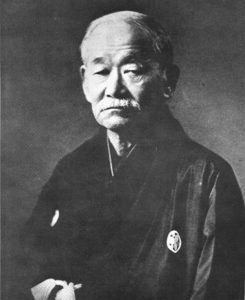
The Kanō Chronicles: The Untold History of Modern Japan® (嘉納歴代史:知らず近代日本史®) is the result of over 15 years of research into the life and times of Kanō Jigorō, 嘉納治五郎 (1860-1938), the founder of jûdô 柔道. In traditional jūdō texts and by today’s jūdōka 柔道家 (judo practitioners) he is normally addressed as ‘Kano shihan’ 師範 (Master Kano).*
No English or Japanese language biographies of Kano shihan capture the complexity of the man and his times. Even the best Japanese biographies are often narrow, typically focused on Kano’s jūdō, education, sports, or Olympic activities, or some combination thereof. There are exceptions, but they are rare and difficult to digest, even for native Japanese, and have escaped the attention of Western researchers.
Context is important, and detailed historical context is not part of Western biographies of Kano. One example can be seen below, in a rare English explanation by Kano shihan of the ‘True Spirit of Judo’.
When I was still young, I learned various types of “jujitsu”.** However, I found it difficult to discover the fundamental principles that decide as to which is the correct method because the teaching of each type was different. Thereupon, in order that I might find out the fundamental principle somehow or other, I began to study seriously. And, in the course of time, I was able to succeed in discovering it. What is this fundamental principle? It is to let our spirit and bodies work most effectively in order to accomplish our purpose, whenever we wish to throw others down, or cut, push, or kick others.
— Kano Jigoro, ‘True Spirit of Judo’, 1938
Rather than the ‘true spirit of jūdō’, a more complete context of the article reveals this to be only the lowest, simplest definition of jūdō espoused by Kanō shihan, meant only as the beginning of a much more complex discussion. As the rest of his discussion is thought not pertinent to today’s sports judo, it is typically discarded, thus lost to generations of judoka who are left with the notion that the epitome of his philosophy is physically controlling your opponent effectively.
Nothing could be further from the truth.
The Kanō Chronicles™ provides the history of Kanō shihan in the context of his times. He lived in a unique period of history, namely the development of Japan from an isolated, feudal backwater to one of the largest empires in history. His patrons, peers, and pupils included princes, prime ministers, politicians, philosophers, prophets, priests, political puppet masters, puppeteers, paupers, oligarchs, generals, admirals, academics, assassins, the assassinated, mandarins, revolutionaries, counterrevolutionaries, reactionaries, samurai, spies, spy masters, sumotori, strike breakers, chancellors, commoners, Christians, Chinese, Confucianists, Communists, women and Class A war criminals.
Kanō shihan personally participated in the initial formation and subsequent reforms of Japan’s education, language, sports, ethics, teacher and moral training, indeed the development and dissemination of its very culture. He thus left an indelible mark on the nation, indeed much of the Empire through the education of thousands of teachers, judoka and their millions of students.
********
* In keeping with the tradition, Japanese names are given in the order LastName FirstName. Note that in the era under study, Japanese often changed their first / given names in recognition of phases or changes in their lives; becoming an adult, reaching 60 years of age, or at any age to designate some eventful political or personal event. Sometimes, frequently; sometimes, in accordance with the stages of life, or simply whimsically. Some phases were chronological: 50, 60, 70, or 80 years old. Nicknames or pen names if known are given in single quotes, ala ‘Konan’, Kano shihan’s penname for calligraphy until his 60th birthday.
** The transliteration of Japanese into Western characters has changed over more than 100 years of use to settle on the current system. This site and associated works use older, nonstandard terms such as jujitsu, jiujutsu, jiudo, Kodokwan, etc. only in direct quotations. Today the rendering of these Japanese terms in Roman letters is unequivocal and universal; judo, jujutsu, Kodokan, etc.
Lance Gatling Author / Lecturer The Kanō Chronicles Tokyo, Japan Contact@kanochronicles.com – please send a note to give us feedback. Thank you!