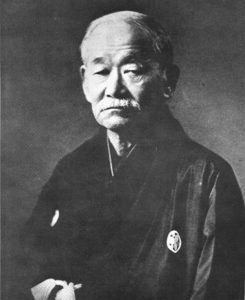
Kanō and his 7000 Chinese students at the Kōbun Gakuin 嘉納歴代 • 嘉納師範と弘文学院 – The Kanō Chronicles

One episode of the life of Kanō shihan (master) not generally appreciated by jūdōka is his extended effort to educate Chinese students. This effort saw him undertake a Meiji government sponsored months’ long, thousands of kilometers official trip through Q’ing dynasty China in which he met mandarins, had secret conversations with overlords, visited the tomb of the founder of orthodox neo-Confucianism, contacted future revolutionaries, and dodged pirates.

Beginning with a small private juku in a rented facility Kanō developed a purpose built school that inducted almost 8,000 Chinese over years, hundreds enrolled at any given time. He first named it 亦楽書院 Jiraku Shoin, a name derived from an ancient Confucian classic text, then again changed the kanji for the new name after being informed by some of his students that such a name violated an obscure ancient naming taboo by using the name of a Chinese Emperor, an affront to traditional Chinese. Today in Japanese we know it as the 弘文学院 Kōbun Gakuin, in Chinese history it is known as the Hongwen Academy.

It was essentially a preparatory school, primarily intended to bring the diverse group of polyglot Chinese students to an acceptable level of comprehension and communications in spoken and written Japanese and a foundation in other topics so the students could later enroll in regular advanced education in Japanese higher education institutes, including Kanō’s own 東京高等師範学校 Tōkyō Kōtō Shihan Gakkō Tokyo Higher Normal School, Japan’s highest teacher training academy. There they would study to become the new teaching cadre that backwards China so desperately needed to modernize its education system. They were joined by a number that went on to study at military or police training facilities until the Japanese government banned the practice.

In teaching Japanese to so many foreigners at once, almost inadvertently the school became one of the foremost working laboratories of teaching the Japanese language, which Kanō himself helped to codify. In mid-Meiji, the school developed a Japanese language training program which it published; the book, Nihongo Kyōkasho, A Japanese Textbook and its training program was so well regarded that it stayed in print for over thirty years.

日本語教科書 Nihongo Kyōkasho Japanese Textbook
Kōbun Gakuin ed.
, 1906

The school remained in operation for years until political propaganda fostered by Europeans and Americans fueled anti-Japanese sentiment to the point that enrollment fell off sharply. Kanō, who lived on the school compound bought for the project in a large house he had built, acquired the huge plot of land years after the school closed and lived there until his death in 1938, when his eldest surviving son and future Kodokan president Kanō Risei inherited the compound.

In the years of the Kōbun Gakuin, Kanō met many men and women who would become key figures in the future of China. Some became founders and political leaders of all three rival Chinese governments vying for power in World War II and its subsequent Civil War, contributing to the deaths of tens of millions of Chinese, as well as teachers and businessmen desperately trying to bolster the faltering China. Some stayed in touch with Kanō for decades afterwards.

The students included future Communists, Nationalists, collaborators with the invading Japanese, soldiers, artists, authors, and even Mao’s father in law. They included: 陈天华、黄兴、李待琛、杨度、胡汉民、牛保才、杨昌济、张澜、朱剑凡、胡元倓、李琴湘、方鼎英、许寿裳、鲁迅、沈心工、陈幼云、陈师曾、陈寅恪、劉勳麟、鲍贵藻, 李四光、侯鸿鉴、郑菊如、李书城、林伯渠、邓以蛰、趙戴文、and 程鴻書.

********

Kanō wrote a forward to the Japanese Textbook in classic Chinese that would be understandable by the Chinese despite their different spoken dialects and varying levels of Japanese skills. It reads:

近時中華文運方興。

Recently there is a Chinese cultural movement.

斯講新学者。

These new scholars.

多資於我日本語日文。

Skilled in our Japanese language and grammar.

而日語文實為中華士子今日必須之学者日増月盛。

And Japanese is actually getting more and more important every day for Chinese scholars。

而教科之書。

However, educational books.

未見其善者。

I have not seen good ones.

定為憾耳。

I regard that as regrettable.

顧言語文字之為学。

The study of speech and writing.

如容易其然。

As easily as possible.

而其實不然者存焉。

But what else?

我宏文学院。**

Our Kōbun Gakuin.

教養中華学生有年。

Educated Chinese students for many years.

我邦語文教授之方。

Our national language professors.

講究已久。

Studied how for a long time.

其成績頗有可觀者。

Men of considerable achievements.

因使教授松本氏編纂日本語科書。

As a result, Professor Matsumoto* compiled this Japanese language book.

諸教授賛助之。

Various professors supported it.

其口語法用例先成。

Its colloquial use cases are established first.

皀以刊行。

And is published with.

而會文法讀本等。

Grammar and a reader, etc.

亦已就諸

It is complete.

其訖助之日

Finally the day of its release!

興此書相待

We welcome this book!

而教授日語日文之資料。

And its teaching material for Japanese and Japanese literature.

庶乎其備矣。

It is almost ready.

抑是書也。

This book.

為華人而作。

Is thus made for Chinese.

然而教授我邦語於一般諸外国人之典型。

Teaching of our Japanese to typical foreigners.

亦不出於此。

Nor is it for this reason.

則是書之所裨益

The benefit of this book.

盖不小也。

is not small, after all.

明治三十九年四月

April Meiji 39 (1906)

宏文学院長嘉納治五郎

Kōbun Gakuin head Kanō Jigorô

– translation ©Copyright 2020 by Lance Gatling, The Kanō Chronicles

Endnotes:

* Matsumoto was the Kōbun Gakuin vice principal and a principal Japanese instructor.

** The first name of the school was 弘文学院 Kōbun Gakuin later changed to 宏文学院 which is also pronounced Kōbun Gakuin in Japanese; not accidentally both are pronounced Hongwen Xuéyuàn in Mandarin, usually rendered as Hongwen Academy in English. We will explore the naming taboo that the original name violated.

Hat tip to Geoff Newman for his translation suggestions! 谢谢!

Lance Gatling
Author / Lecturer
The Kanō Chronicles
Tokyo, Japan
Contact@kanochronicles.com – please send a note to give us feedback.
Thank you!
©Copyright 2020 Lance Gatling – The Kanō Chronicles
Origin of Jūjutsu’s ‘Principle of Flexibility’- Jū no Ri

Kanō shihan wrote and lectured on the principle of 柔 jū, flexibility.  He termed it as 柔の理 Jū no Ri, the Principle of Flexibility.

What is the origin of the term and its concept? What is the correct context?

The primary saying that is used to describe the core philosophy of jūjutsu is the four-character idiomatic Japanese phrase [1]

柔能制剛 Jū nō sei gō

Flexibility overcomes strength [2]

Or, more often cited in the West, but less correctly ‘Softness overcomes strength’ [3]

This saying is used to describe the core philosophy of jūjutsu – do not fight strength against strength, but rather deflect or avoid to neutralize the power thus wasted in attacking you.

But that is only the introductory line of the Upper Strategy, a portion of a much longer text. The complete primary text of the Upper Strategy of The Three Strategies of Huang Shingong (Chinese: 黃石公三略: Huang shigong sanlüe) from nearly 2250 years ago reads:

「軍識曰、柔能制剛、弱能制強。柔者徳也、剛者賊也。弱者人之所助、強者怨之所攻。    柔有所設、剛有所施、弱有所用、強有所加。兼此四者、而制其宣。」

Below is the first known complete English translation
(©2020 Lance Gatling, The Kanō Chronicles)

軍讖曰: The “Military Prophecies” cites:

柔能制剛 Flexibility controls the strong,

弱能制強 weakness controls strength.

柔者徳也 The flexible have virtues,

剛者賊也 the unyielding have faults.

弱者人之所助 The weak attract assistance,

強者怨之所攻 the strong attract opposition.

柔有所設 At times use flexibility,

剛有所施 at times use hardness,

弱有所用 at times use weakness,

強有所加 at times add strength.

兼此四者 One using all four

而制其冝 will then prevail. [4]

The primary purpose of the strategy was to cultivate effective interpersonal relations for leaders and rulers, how to deal with their own people. In the extended commentary it is clearly about dealing with subordinates first. The extension of the strategy since then was how to deal with non-subordinates, including enemies.

As one of China’s Seven Military Classics, this work has been studied for over 2000 years as one of China’s most important traditional schools of strategic thought.

Regarding its use in describing  jūdō, apparently Kanō shihan thought it was insufficient to capture his vision; therefore, he developed his own explanation of the basic principles of jūdō that went through various versions, but eventually he settled on:

Seiryoku zen’yō Jita kyōei

This is typically translated into English as:

Best Use of Energy / Mutual Benefit

The origin of Kanō’s jūdō philosophies is complex, a tale that is explored in The Origins and Development of Kanō Jigorō’s Jūdō Philosophies by Lance Gatling, International Judo Federation Arts and Science of Judo , Vol. 1, No. 2, December 2021, pages 50-64, available at

https://tinyurl.com/4utm4s5t

Lance Gatling

Tokyo, Japan

info@kanochronicles.com

Endnotes:

[1] Japanese and Chinese use thousands of four character ideograms called yojijukugo in Japanese. These are used as in a wide array of situations from sayings to mnemonics to short hand for long stories or legends. Many are thousands of years old.

[2] 柔能制剛 Jū nō sei gō is Chinese. It is rendered in Japanese as 柔よく制剛  jū yoku sei gō the quality of flexibility / softness controls rigidity / hardness.

[3]  The author contends that the typical translation of into English as ‘softness’ is neither correct nor appropriate in historical context and for the purposes of understanding jūjtsu or jūdō. 

[4]San Lüe 三略 (Three Strategies) is divided into three parts: Shang Lüe 上略, Zhong Lüe 中略, and Xia Lüe 下略. The first two parts quote from military writings of the past, Jun Chen 軍讖 (Military Prophecies) and Jun Shi 軍勢 (Military Power) and elaborates them, while the third part is the author’s own discussion. Some attribute the work to Huang Shigong 黃石公, but in recent research, it is said that this book was written by an anonymous person between the Qin dynasty (221–206 BC) and Han dynasty (206 BC–220 AD). “

From: The Governing Principles of Ancient China, Volume 2 – Based on 360 passages excerpted from the original compilation of Qunshu Zhiyao (The Compilation of Books and Writings on the Important Governing Principles), pg 508. Seri Kembangan, Malaysia: Chung Hua Cultural Education Centre, 2014.

Author note to FN 4: It is also entirely possible, indeed, perhaps likely that the Military Prophecies is in fact a fabrication added to imbue this work with more gravitas by “quoting” a much more ancient text than the newer work itself would import, as it seems there are no indications outside the Three Strategies that the Military Prophecies ever existed. Such a fabrication is not unknown in ancient Chinese texts (and those of other cultures).

Notes:

The entire work’s name in English is usually rendered as the The Three Strategies of Huang Shigong.

The Shang Lüe 上略, Zhong Lüe 中略, and Xia Lüe 下略 are respectively the Upper Strategy, the Middle Strategy, and the Lower Strategy.

The exact date of the Military Prophecies seems unknown but appears to be around 2400 years old.

English translation ©Copyright 2020, 2023 by Lance Gatling, The Kanō Chronicles  

Lance Gatling
Author / Lecturer
The Kanō Chronicles
Tokyo, Japan
Contact@kanochronicles.com – please send a note to give us feedback.
Thank you!

aikido Asian philosophy budo china Chinese philosophy Chinese students dojo dracula education history japan japanese history jigoro-kano jiujutsu judo judo jujutsu japanese history japan jujitsu kano kodokan budo bushido kano jigoro judo philosophy jujutsu Kano Jigoro keiko-fukuda Kobun Gakuin Kodokan Kodokan judo land use martial arts martial arts philosophy meiji japan history most valuable martial art philosophy principle of flexibility Seiryoku Zenyo Jita Kyoei Three Strategies tokyo womens-judo 三略 哲学 嘉納治五郎 柔の理 柔術 柔道 柔道哲学 武術 武道 講道館柔道 黃石公三略