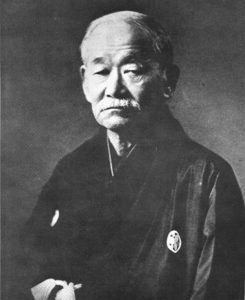
The following is a transcript of an essay (or speech? its origin is not stated) by Kanō Jigorō regarding the “true spirit of jūdō”. It is one of the last Kanō made in English, this time to the Japan Times & Mail, a long published English language newspaper printed for the foreign community in Japan. It is not clear if Kanō shihan wrote this or dictated it for transcription.
The added endnotes are to explain some aspects that may not be clear to casual observers.
The Japanese terms were originally without italics or capitalization, so edited for clarity.
I hope you enjoy it – any questions are welcome, and you can sign up to receive email notices of updates by entering your email in the blank below.
The Superintendent of the Kodokwan[i] When I was still young, I learned various types of “jujitsu“.[ii] However, I found it difficult to discover the fundamental principles that decide as to which is the correct method because the teaching of each type was different. Thereupon, in order that I might find out the fundamental principle somehow or other, I began to study seriously. And, in the course of time, I was able to succeed in discovering it. What is this fundamental principle? It is to let our spirit and bodies work most effectively in order to accomplish our purpose, whenever we wish to throw others down, or cut, push, or kick others. Having found out this principle, I put my whole effort to studying various tricks[iii] of time-honored jujitsu of different types according to it……
***************** Please see the attached pdf below for the entire article and my notes. You can read it online via a web browser, or download the entire file. Feel free to ask questions if something is not clear! and let me know what you think of our new logo!!
Or, more often cited in the West, but less correctly ‘Softness overcomes strength’ [3]
This saying is used to describe the core philosophy of jūjutsu – do not fight strength against strength, but rather deflect or avoid to neutralize the power thus wasted in attacking you.
But that is only the introductory line of the Upper Strategy, a portion of a much longer text. The complete primary text of the Upper Strategy of The Three Strategies of Huang Shingong (Chinese: 黃石公三略: Huang shigong sanlüe) from nearly 2250 years ago reads:
The primary purpose of the strategy was to cultivate effective interpersonal relations for leaders and rulers, how to deal with their own people. In the extended commentary it is clearly about dealing with subordinates first. The extension of the strategy since then was how to deal with non-subordinates, including enemies.
As one of China’s Seven Military Classics, this work has been studied for over 2000 years as one of China’s most important traditional schools of strategic thought.
Regarding its use in describing jūdō, apparently Kanō shihan thought it was insufficient to capture his vision; therefore, he developed his own explanation of the basic principles of jūdō that went through various versions, but eventually he settled on:
Seiryoku zen’yō Jita kyōei
This is typically translated into English as:
Best Use of Energy / Mutual Benefit
The origin of Kanō’s jūdō philosophies is complex, a tale that is explored in The Origins and Development of Kanō Jigorō’s Jūdō Philosophies by Lance Gatling, International Judo Federation Arts and Science of Judo , Vol. 1, No. 2, December 2021, pages 50-64, available at
[1] Japanese and Chinese use thousands of four character ideograms called yojijukugo in Japanese. These are used as in a wide array of situations from sayings to mnemonics to short hand for long stories or legends. Many are thousands of years old.
[2] 柔能制剛 Jū nō sei gō is Chinese. It is rendered in Japanese as 柔よく制剛 jū yoku sei gō the quality of flexibility / softness controls rigidity / hardness.
[3] The author contends that the typical translation of jū into English as ‘softness’ is neither correct nor appropriate in historical context and for the purposes of understanding jūjtsu or jūdō.
[4] “San Lüe 三略 (Three Strategies) is divided into three parts: Shang Lüe 上略, Zhong Lüe 中略, and Xia Lüe 下略. The first two parts quote from military writings of the past, Jun Chen 軍讖 (Military Prophecies) and Jun Shi 軍勢 (Military Power) and elaborates them, while the third part is the author’s own discussion. Some attribute the work to Huang Shigong 黃石公, but in recent research, it is said that this book was written by an anonymous person between the Qin dynasty (221–206 BC) and Han dynasty (206 BC–220 AD). “
From: The Governing Principles of Ancient China, Volume 2 – Based on 360 passages excerpted from the original compilation of Qunshu Zhiyao (The Compilation of Books and Writings on the Important Governing Principles), pg 508. Seri Kembangan, Malaysia: Chung Hua Cultural Education Centre, 2014.
Author note to FN 4: It is also entirely possible, indeed, perhaps likely that the Military Prophecies is in fact a fabrication added to imbue this work with more gravitas by “quoting” a much more ancient text than the newer work itself would import, as it seems there are no indications outside the Three Strategies that the Military Prophecies ever existed. Such a fabrication is not unknown in ancient Chinese texts (and those of other cultures).
Notes:
The entire work’s name in English is usually rendered as the The Three Strategies of Huang Shigong.
The Shang Lüe 上略, Zhong Lüe 中略, and Xia Lüe 下略 are respectively the Upper Strategy, the Middle Strategy, and the Lower Strategy.
The exact date of the Military Prophecies seems unknown but appears to be around 2400 years old.

 The Kano Chronicles© 嘉納歴代©