Origin of Jūjutsu’s ‘Principle of Flexibility’- Jū no Ri

Kanō shihan wrote and lectured on the principle of 柔 jū, flexibility.  He termed it as 柔の理 Jū no Ri, the Principle of Flexibility.

What is the origin of the term and its concept? What is the correct context?

The primary saying that is used to describe the core philosophy of jūjutsu is the four-character idiomatic Japanese phrase [1]

柔能制剛 Jū nō sei gō

Flexibility overcomes strength [2]

Or, more often cited in the West, but less correctly ‘Softness overcomes strength’ [3]

This saying is used to describe the core philosophy of jūjutsu – do not fight strength against strength, but rather deflect or avoid to neutralize the power thus wasted in attacking you.

But that is only the introductory line of the Upper Strategy, a portion of a much longer text. The complete primary text of the Upper Strategy of The Three Strategies of Huang Shingong (Chinese: 黃石公三略: Huang shigong sanlüe) from nearly 2250 years ago reads:

「軍識曰、柔能制剛、弱能制強。柔者徳也、剛者賊也。弱者人之所助、強者怨之所攻。    柔有所設、剛有所施、弱有所用、強有所加。兼此四者、而制其宣。」

Below is the first known complete English translation
(©2020 Lance Gatling, The Kanō Chronicles)

軍讖曰: The “Military Prophecies” cites:

柔能制剛 Flexibility controls the strong,

弱能制強 weakness controls strength.

柔者徳也 The flexible have virtues,

剛者賊也 the unyielding have faults.

弱者人之所助 The weak attract assistance,

強者怨之所攻 the strong attract opposition.

柔有所設 At times use flexibility,

剛有所施 at times use hardness,

弱有所用 at times use weakness,

強有所加 at times add strength.

兼此四者 One using all four

而制其冝 will then prevail. [4]

The primary purpose of the strategy was to cultivate effective interpersonal relations for leaders and rulers, how to deal with their own people. In the extended commentary it is clearly about dealing with subordinates first. The extension of the strategy since then was how to deal with non-subordinates, including enemies.

As one of China’s Seven Military Classics, this work has been studied for over 2000 years as one of China’s most important traditional schools of strategic thought.

Regarding its use in describing  jūdō, apparently Kanō shihan thought it was insufficient to capture his vision; therefore, he developed his own explanation of the basic principles of jūdō that went through various versions, but eventually he settled on:

Seiryoku zen’yō Jita kyōei

This is typically translated into English as:

Best Use of Energy / Mutual Benefit

The origin of Kanō’s jūdō philosophies is complex, a tale that is explored in The Origins and Development of Kanō Jigorō’s Jūdō Philosophies by Lance Gatling, International Judo Federation Arts and Science of Judo , Vol. 1, No. 2, December 2021, pages 50-64, available at

https://tinyurl.com/4utm4s5t

Lance Gatling

Tokyo, Japan

info@kanochronicles.com

Endnotes:

[1] Japanese and Chinese use thousands of four character ideograms called yojijukugo in Japanese. These are used as in a wide array of situations from sayings to mnemonics to short hand for long stories or legends. Many are thousands of years old.

[2] 柔能制剛 Jū nō sei gō is Chinese. It is rendered in Japanese as 柔よく制剛  jū yoku sei gō the quality of flexibility / softness controls rigidity / hardness.

[3]  The author contends that the typical translation of into English as ‘softness’ is neither correct nor appropriate in historical context and for the purposes of understanding jūjtsu or jūdō. 

[4]San Lüe 三略 (Three Strategies) is divided into three parts: Shang Lüe 上略, Zhong Lüe 中略, and Xia Lüe 下略. The first two parts quote from military writings of the past, Jun Chen 軍讖 (Military Prophecies) and Jun Shi 軍勢 (Military Power) and elaborates them, while the third part is the author’s own discussion. Some attribute the work to Huang Shigong 黃石公, but in recent research, it is said that this book was written by an anonymous person between the Qin dynasty (221–206 BC) and Han dynasty (206 BC–220 AD). “

From: The Governing Principles of Ancient China, Volume 2 – Based on 360 passages excerpted from the original compilation of Qunshu Zhiyao (The Compilation of Books and Writings on the Important Governing Principles), pg 508. Seri Kembangan, Malaysia: Chung Hua Cultural Education Centre, 2014.

Author note to FN 4: It is also entirely possible, indeed, perhaps likely that the Military Prophecies is in fact a fabrication added to imbue this work with more gravitas by “quoting” a much more ancient text than the newer work itself would import, as it seems there are no indications outside the Three Strategies that the Military Prophecies ever existed. Such a fabrication is not unknown in ancient Chinese texts (and those of other cultures).

Notes:

The entire work’s name in English is usually rendered as the The Three Strategies of Huang Shigong.

The Shang Lüe 上略, Zhong Lüe 中略, and Xia Lüe 下略 are respectively the Upper Strategy, the Middle Strategy, and the Lower Strategy.

The exact date of the Military Prophecies seems unknown but appears to be around 2400 years old.

English translation ©Copyright 2020, 2023 by Lance Gatling, The Kanō Chronicles  

Lance Gatling
Author / Lecturer
The Kanō Chronicles
Tokyo, Japan
Contact@kanochronicles.com – please send a note to give us feedback.
Thank you!

Asian philosophy budo china Chinese philosophy Chinese students dojo dracula education history japan japan-times japanese history jigoro-kano jiujutsu judo judo jujutsu japanese history japan jujitsu kano kodokan budo bushido kano jigoro judo philosophy jujutsu Kano Jigoro keiko-fukuda Kobun Gakuin Kodokan Kodokan judo land use martial arts martial arts philosophy meiji japan history most valuable martial art philosophy principle of flexibility Seiryoku Zenyo Jita Kyoei Three Strategies tokyo womens-judo 三略 哲学 嘉納治五郎 柔の理 柔術 柔道 柔道哲学 武術 武道 講道館柔道 黃石公三略

Viscount Shinagawa Yajirō and the Fujimichō Kōdōkan – The Kanō Chronicles®

Among the many locations of the Kodokan in its early days (1882-1900) was one that Kanō shihan (master) explains in some detail: the Fujimi-chō dōjō (literally, ‘place of the way’, originally a Buddhism term denoting a place of austere study, adopted by Japanese martial arts to indicate a place of practice and austere study).

In his early 20s, from the early to mid 1880s, Kanō became acquainted with key Chōshū han samurai who variously fought with or led Chōshū military units fighting in the Satsuma – Chōshū han led coup that seized control of Japan in what is termed the Meiji Restoration. This long series of events and their aftermath led to a young Chōshū samurai named Murata Genzō studying English under Kanō. (Satsuma and Chōshū were only two of the around 260 han domains of old Japan, but two of the most powerful and most in tension with the bakufu. Sited in today’s Kagoshima and Yamaguchi prefectures respectively, these powerful han existed about as far as you could get from Tokyo and still be in Japan, and were jealous and suspicious of the Tokugawa bakufu military dictatorship / administration and protective of their own prerogatives. In alliance with lesser allies the senior samurai of these two han led the battles and political struggles of the Restoration, the overthrow of the over 260 year old Tokugawa regime and the establishment of a new government with the Emperor as its titular leader, advised, of course, by his new Imperial supporters.)

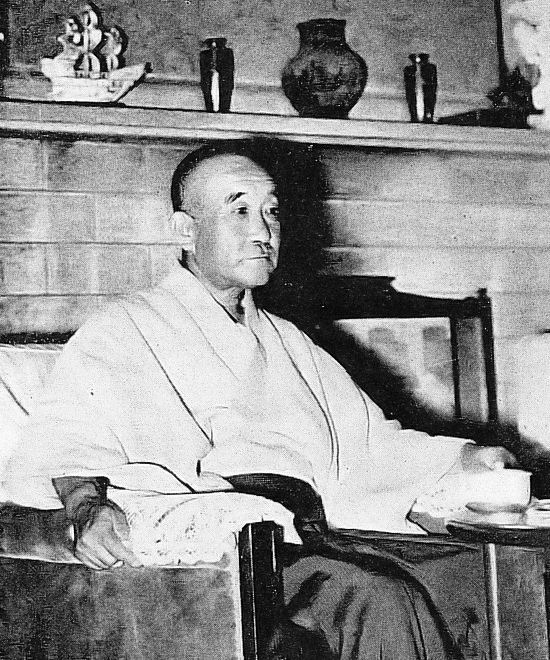
Murata told Kanō that he wanted to travel and study overseas but could not afford to do so. Through Murata, Kanō met Viscount Shinagawa Yajirō (1843-1900), a senior Chōshū samurai colleague of Murata and one of the rising stars in the new Meiji government. Kanō consulted with Shinagawa and his senior colleague and patron, then Count (later Prince under the new Meiji peerage system) General Yamagata Aritomo about how they could support Murata. In the end, Yamagata asked the young Kanō, then in his twenties, to lead a private subscription drive to support Murata. Kanō agreed and eventually successfully collected enough money from other senior Chōshū samurai and his own merchant commoner friends to underwrite Murata’s subsequent overseas study trip. In doing so, Kanō met many of the Choshu former samurai warrior / scholars, assassins, and Imperial ideologues who formed the core of the Meiji government and Army for decades. Shinagawa Yajirō was one of the most notorious of these colorful and powerful men.

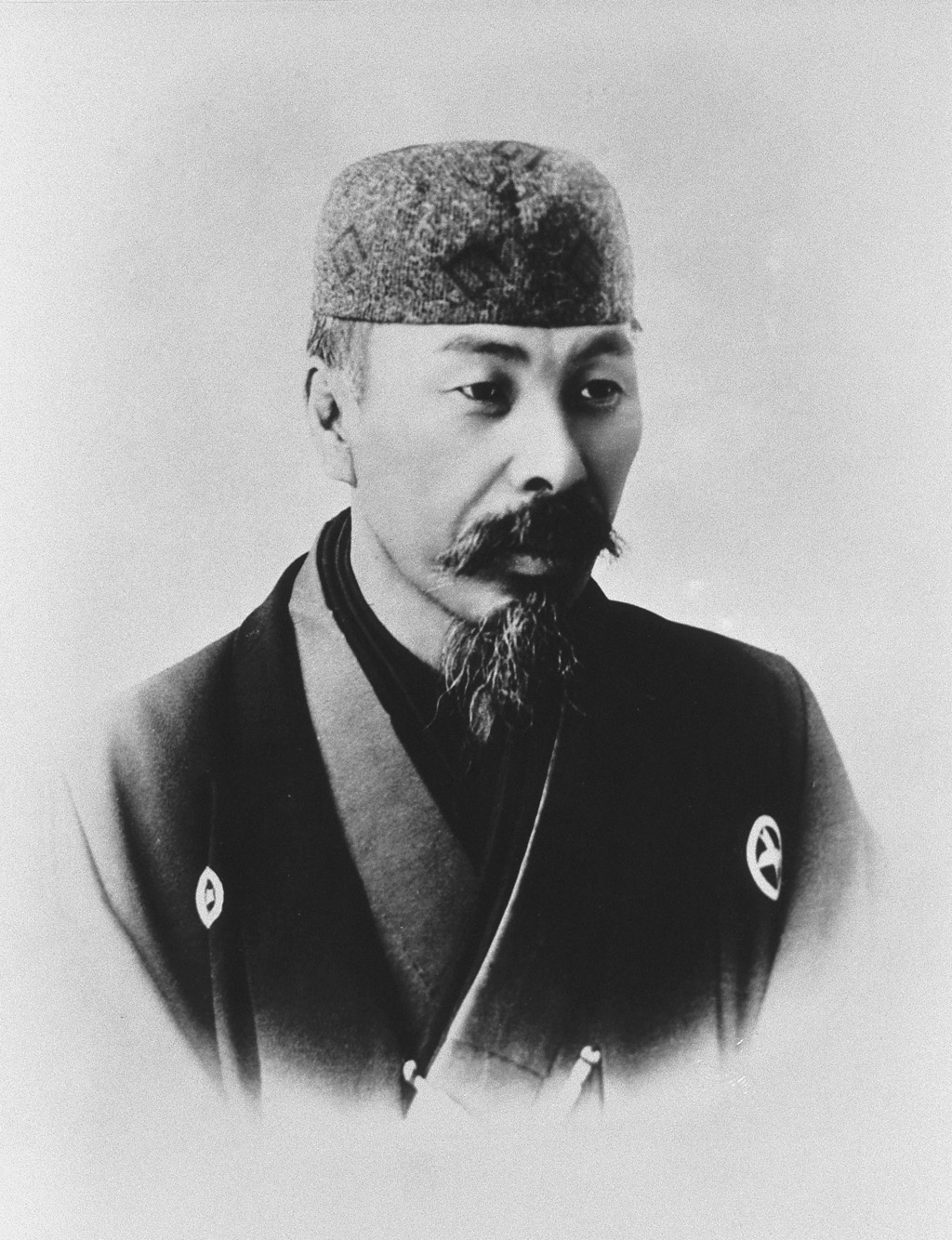
Viscount Shinagawa Yajirō (1843-1890) Wiki Commons pic
Arsonist, assassin, warrior, revolutionary hero, Meiji government minister
(Image Wiki Commons)
Continue reading “Viscount Shinagawa Yajirō and the Fujimichō Kōdōkan – The Kanō Chronicles®”

Runaway Horses: Art in the Kodokan – The Kano Chronicles®

Kanō shihan was not described as an aficionado of the arts, but he owned one piece of art that seems to have captured his imagination: a large pair of traditional Japanese byobu screens depicting five madly galloping, runaway horses.  These screens can be seen in years of photographs of the Kodokan, displayed to either side of his ever present (and still displayed) seat and desk at the front of the Dai Dōjō, where they are still displayed today in the new Kodokan Great Dojo.

In 1906 Kanō saw an exhibit by young artist Konoshima Okoku[1] and tried to buy one of his screens on display. Okoku responded that those works on display were not for sale, so Kanō  commissioned him to make a remarkable painting—a huge two eight-panel screen set showing five madly galloping horses. The massive 奔馬 Honba ‘Runaway Horses’ screen set became a fixture in the Kōdōkan, displayed in the Dai Dōjō during important events but normally displayed in Kano’s kanchō institute head’s office in the Kodokan.

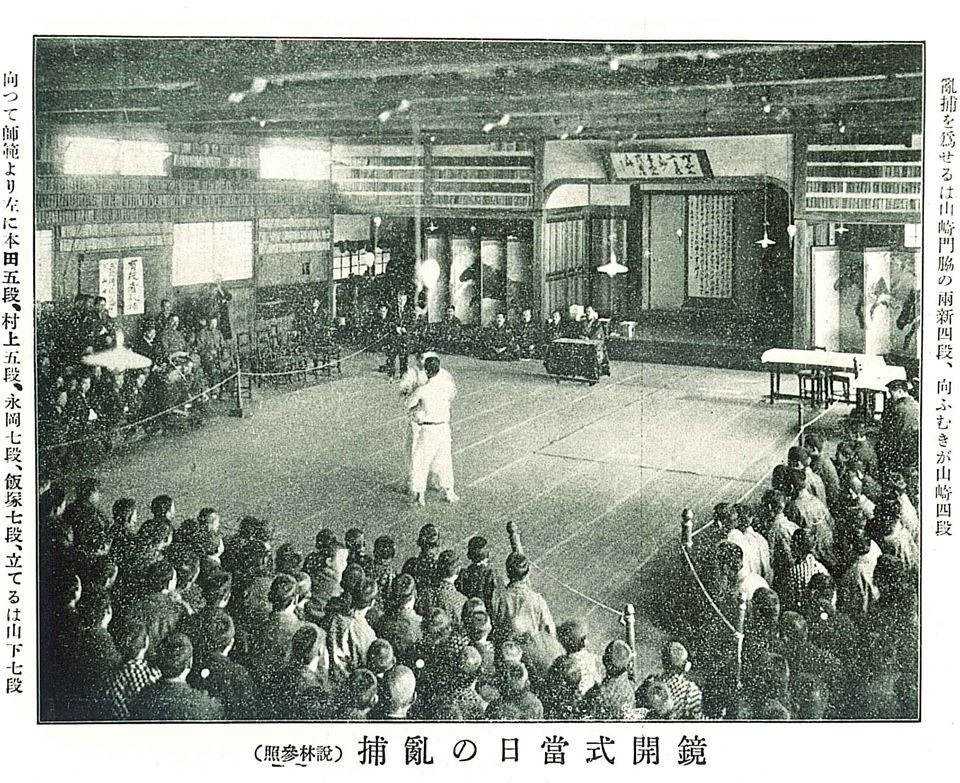
They can be seen here, in the Dai Dojo of the old Kodokan, during a kagamibiraki New Year ceremony, a tradition still followed today.

Kagami Biraki Kodokan date unknown

Other points of interest in the photo are the name boards and the hanging scroll in the alcove. The box formats correspond to the margin notes.

Screen Shot 2020-01-13 at 13.16.45

The set is huge; note how they tower over the seated Kano in the photo above.

Below is a photo of the two screens stacked, fully open flat (they were normally displayed separated left and right, in a partial fold, the normal display method for free standing screens).  The top two-horse screen is shown to the left above.

(Image courtesy Oukoku Bunko, Kyoto, Japan, the NPO that owns the museum housing Okoku’s works, former home and workshop.)

Okoku Honba Runaway Horses

The screens were both lost when the Kodokan was partially destroyed during a 1945 firebomb raid (see The Firebombing of the Kodokan 1945 for details) and part of the Dai Dojo and the kancho office burned. A napalm bomblet landed on the Kodokan roof just above the far wall in the photo above and burned through the rood and into the Dai Dojo below.

In a final bit of irony, Kano shihan was noted as a less than expert horseman, apparently having fallen off horses with some regularity, at least once while riding to the Kodokan. While his personal interviews apparently do not mention it, a number of contemporary accounts refer to his mishaps.

[1]  See http://www.oukokubunko.org/sp/access6044.html

Oukoku Bunkō English website

Oukoku  Bunko Address:  56  Higashi-machi, Tojiin,  Kita-Ward,  Kyoto,  603-8343  Japan

URL:  http://www.oukokubunko.org

Facebook  URL:  http://www.facebook.com/okokubunko/

Contact :info@oukokubunko.org

Open  to  the  public  on  every  Friday,  Saturday,  Sunday  and  Public  Holiday

Hours  are  from  10am  to  4pm.  (info above from website, suggest confirming before going) 

Lance Gatling
Author / Lecturer
The Kanō Chronicles
Tokyo, Japan
Contact@kanochronicles.com – please send a note to request signup for automatic updates or give us feedback.
Thank you!
©Copyright 2020 Lance Gatling – The Kanō Chronicles

The Kano Chronicles® – Kano shihan in fact and fiction Part I – Kano battles Dracula (⁉️)

Athough he kept an English diary for decades that has been carefully kept from the public, Kano shihan apparently never wrote an autobiography. What he did provide was a long series of interviews with frequent Sakkô contributor / journalist / judoka Ochiai Torahei covering his personal life, his career as an educator and experience as a judoka. This material has been available in Japanese for many years – first published in a series of twenty-four long articles from Jan 1927 to May 1929 in the Kodokan Culture Council monthly magazine Sakkô (‘Arousal’), there have been various extracts and versions reprinted in several postwar collections of Kanō shihan’s writings.

There is an English version of the Sakkô serialized interviews that covers around 200 pages of dense text and is the single best book available in English to date on Kanō shihan’s life. The meticulously translated Judo Memoirs of Jigoro Kano by judoka and long term Japan resident Brian N. Watson is a unique contribution to make judo history accessible in English. Brian’s book is an indispensable reference for any serious judoka and a fascinating read that took years of knowledgeable effort to complete; I recommend it unreservedly.

In the Sakkô memoirs Kanō shihan describes his life, career, and judo in his own words, in his late 60s, after his retirement from the Ministry of Education, and after his Imperial nomination to the Japan’s Upper House, where he won election in 1922 and then sat as the equivalent of a member of the UK House of Lords or as a US Senator until his death in 1938. (Spoiler alert: Kanō shihan’s version of events in certain places is biased towards him, with all that entails. Some very serious judo history researchers have noted there are no independent supporting contemporaneous accountants of some episodes that have since become core to the legends of judo. Cf. the legendary ‘Police judo matches’ of the 1890s, EN1.)

In addition, there are scores if not hundreds of contemporary and later Japanese and foreign language profiles and mini-biographies of Kanō, starting in the late 1890s in magazines, newspapers, academic journals and books.

But unknown to most folks are the works of fiction in which Kano appears.

Perhaps the most intriguing is the novel “The Tale of Meiji Dracula: The Apparition Appears in the Imperial Capital” 『明治ドラキュラ伝: 妖魔, 帝都に現る』 by Kikuchi Hideyuki, published in 2004. Kikuchi was the author of numerous Japanese vampire novels. In this one, set in the 1880s in Meiji Tokyo, a twenty-something Kano teams with his (real world) favorite judo deshi Saigo Shiro and the fictional 17 year old swordmaster Minazuki Daigo to battle Dracula, who appears in Japan to complete a centuries old mission that I leave for the reader to discover.

Interestingly, this novel was translated into English as Dark Wars: The Tale of Meiji Dracula in 2008. (I don’t have a copy; if anyone reads it, I’d welcome more information.)

Next, we’ll look at the fictional version of young Kano Jigoro when he fights not just Dracula but nearly everyone.

EN1: An anonymous scholar acquaintance spent hours looking for evidence of the famous ‘police jujutsu competitions’ and told me he came up empty-handed, which in turn spurred me to look, too. Neither of us uncovered any contemporaneous articles in newspapers of the day, which we thought very strange; such activities by the police were normally very carefully covered by the press. Only 20-30 years later do the tales appear of the great police jujutsu tournament in which the Kodokan judoka were victorious and were hired as police jujutsu its allies, but only from Kano shihan and his supporters.. While it is entirely possible there was such an event, it seems more likely that if it did exist, it was a relatively small affair. Certainly some Kodokan judoka were hired as Tokyo Metropolitan Police jujutsu instructors around that time, but so were instructors from a number of other, different jujutsu schools; the public records of this are clear. The entire affair may be a combination of some (ahem…..) exaggeration on the part of Kanō shihan and his hagiographers and most definitely misunderstanding of the complex relationship of the Tokyo Metropolitan Police with martial arts, particularly kenjutsu (sword) and jujutsu (grappling).

To be continued…..

Lance Gatling
Author / Lecturer
The Kanō Chronicles
Tokyo, Japan
Contact@kanochronicles.com – please send a note to request signup for automatic updates or give us feedback.
Thank you!
©Copyright 2019 The Kanō Chronicles – Lance Gatling


The writings and lectures of Kanō shihan – known, unknown and lost

Probably less than 10% of Kanō shihan’s numerous writings have been translated into any Western language, or even extracted or summarized.

His first known articles, on philosophy, were published in the mid-1880s while Kanō shihan was in his 20s. Over 50 years he contributed scores of articles to multiple publications on topics ranging from physical education, ethics, education, the Olympics, international geopolitics, China, politics, physical and moral courage, death, his incessant theme of 精力善用自他共栄 Seiryoku Zen’yô Jita Kyôei, even a commentary on a poem by the Meiji Emperor, who granted Kanō multiple audiences. Kanō shihan also contributed scores of forwards for the books of friends and acquaintances on topics from kobudô 古武道 to 武士道 bushidô to 神道 Shintô to ethics and morality; in one he admitted he hadn’t even read the book, but supported the author, his personal student.

He lectured widely and at great length – he loved to talk. While many of his impromptu lectures went unrecorded, some key lectures were prepared or transcribed. A number of his transcribed speeches must run over 30 minutes. A single question on education policy during an early 1930s Diet Upper House 貴族院 interpellation he posed to the Minister of Education took around 20 minutes; thankfully the Minister’s answer was mercifully terse.

In one private school New Year’s celebration as one of a small number of dignitaries given three minutes to provide short greetings, he ended by apologizing for talking nearly 20 instead, providing a long allegory criticizing the Second Sino-Japanese War. At one formal group dinner in Tokyo he talked for nearly 45 minutes nonstop after drinks and dinner then apologized – he had gone so far over the allotted time he had to leave immediately, and had no time for questions or comments, but instead asked a member of the head table to provide his car so he could depart from Tokyo Station.

The tale of the dinner address made me wonder how many people it put to sleep, as the recollections of his high school students sometimes commented on how long and boring his lectures could be. One European account detailing his address of an International Olympic Committee working dinner leaves no doubt; he started by extolling the advantages of Tokyo as an Olympic Games venue at length then departed on a tangent on judo that went on and on and on. The description of the result is not vague – many of the attending IOC members, many from far lands, late at night, well fed, some tipsy, and most probably at a loss to understand the importance or pertinence of judo, some not understanding English well, simply fell sleep.


And certainly he wrote on judo. He produced stacks of judo lectures, articles, essays, interviews, etc. Often repetitive and nearly formulaic, some include gems of new information and insights.


While traveling, he wrote newsy, factual and analytical letters and sent telegrams on important topics. He gave interviews to print media and live radio programs around the world to support his personal and policy objectives, primarily in English, but apparently a few times in less than fluent French and German.

A member of the International Olympic Committee from 1909 until his death, he corresponded with the leadership and staff in English. Kano shihan primarily wrote in Japanese and English, but occasionally in French and not infrequently in early Meiji in 漢文 kanbun, the ancient Sino-Japanese script of pre-Meiji Japan. His later writing in modern Japanese evolved in style over the decades for multiple reasons, but he was seldom concise and direct in his explorations of anything, much less complex topics.

Kanō most often wrote alone, but he did collaborate with others. One of his frequent collaborators was Watari Shôsaburô, an ethics instructor and kendoka at the Tokyo Higher Normal School where Kano was the principal.

For over 20 years I’ve collected his writings and transcriptions of his addresses, an uncounted total but surely hundreds to date. I suspect there are at least scores more. In the search I’ve found many surprises in the development of his thoughts, the range of his acquaintances, his plans for education, the Olympics (the current topic in Japan), and his true plan for judo. Only infrequently does his own character emerge; he wrote briefly, poignantly of the loss of family members in the Great Kanto Earthquake in 1923 but then noted his gratitude, as his own home was not severely damaged, while so many others had lost so much, some losing everything.

His most striking writing is arguably is one of his last messages, unknown until very recently. It was recently discovered in a friend’s private library, actually delivered after Kanō shihan departed for the 1938 Cairo IOC meeting in February 1938; the missive provides striking new, private insight into the mind of a man obsessed with accomplishing his last critical mission for Japan, securing the 1940 Olympics Games for Tokyo. He departed for Cairo when he was almost 78 and in marginal health from decades of chronic disease. It was a long, arduous trip encircling the planet, one he insisted on taking alone, one that sapped his strength and one from which he would not return alive.

Two major questions regarding his writings remain today –

  1. Did he publish articles under one penname or another? There are a number of articles to topics dear to him that were clearly written under assumed names or clear pennames that read like the work of Kano shihan.
  2. Where are his lost texts? There are at least two instances where Kano shihan very specifically mentions important extended texts he prepared but they were apparently never printed.

And so the hunt continues.


Lance Gatling
Author / Lecturer
The Kanō Chronicles
Tokyo, Japan
Contact@kanochronicles.com – please send a note to request signup for automatic updates or give us feedback.
Thank you!
©Copyright 2019 – Lance Gatling, The Kanō Chronicles


The Kano Chronicles® – future posts

Future posts in progress, in no particular order. Please let me know what you’d like to see first and I’ll see what I can do!


     The Kanō Chronicles® – Kanō and the House of Peers Nominated by the Emperor Taishō, ‘Senator’ Kanō goes from backbencher to key figure.


The Kanō Chronicles® –                    Seiryoku Zen’yō / Jita Kyōei 

Just exactly what does this mean?
What are its origins?
Who cares, anyhow?

The Kanō Chronicles® –                           Kanō shihan and General Tōjō discuss training methods                                 (spoiler: They disagree. A lot.)

The Kanō Chronicles® – Kanō shihan and weapons
An armed Kanō was a happy Kanō


The Kanō Chronicles® – Kanō steals the 1940 Olympics for Tokyo


The Kanō Chronicles® – Wartime Kōdōkan  From the Sino-Japanese War to the two China Incidents to World War II (and the Cold War)


The Kanō Chronicles® – Kanō’s plan to control Japanese budo
What happened?


 The Kanō Chronicles® – Kanō and female jūdōka:
Isolation and secret lessons

The Kanō Chronicles® – Kanō’s plan to save Japanese soldiers’ families


The Kanō Chronicles® – Kanō’s National Physical Education 国民体育 Kokumin Taiiku
Kanō style martial arts for the masses


The Kanō Chronicles® – Kanō’s secret war zone mission
Why is a school principal sent on a secret mission into an active war zone, dodging bullets and enemy ships ? 


The Kanō Chronicles® – Kanō’s banned books
MacArthur was not pleased                             


The Kanō Chronicles® – Nangō Jirō and the Kōdōkan
Introducing Imperial Japanese Navy Rear Admiral Nangō Jirō: Kanō’s nephew, juku student, combat Marine, 3rd dan jūdōka, and the second head of the Kōdōkan Jūdō Institute

Kanō Chronicles® – Kanō’s brother in law Admiral Yanagi Narayoshi Kanō Jirōsaku’s workmate, navigator, mathematician, astronomer, cartographer, and member of the genrōsha Imperial council

The Kanō Chronicles® – The deaths of Kanō’s sons


The Kanō Chronicles® – Kanō’s homes


The Kanō Chronicles® – Kanō’s secret lessons
Judo to the unteachable


The Kanō Chronicles® – Kanō’s funeral and tomb


The Kanō Chronicles® – Kanō’s judo spies in China and Russia


The Kanō Chronicles® – Kanō’s faction in the House of Peers 貴族院派閥


The Kanō Chronicles® – Kanō, the Kōdōkan, and the Gods of War


The Kanō Chronicles® – Kanō’s secret laboratory


The Kanō Chronicles® – Kanō Jirōsaku, Kanō’s father
Shintō and sake, lumber and lighters, dying in service to the Emperor


The Kanō Chronicles® –  Kanō’s spy in the US


The Kanō Chronicles® –  Kanō and the Asiatic Society of Japan

The Kanō Chronicles® – Kanō and the Gods Kanō and Shintō, the Japanese ‘Way of the Gods’

The Kanō Chronicles® – Who or what killed Kanō?

The Kanō Chronicles® – The four stages of Nihon den Kōdōkan jūdō

Lance Gatling
Author / Lecturer
The Kanō Chronicles
Tokyo, Japan
Contact@kanochronicles.com – please send a note to request signup for automatic updates or give us feedback.
Thank you!

The Kano Chronicles® – Japanese Physical Education 1915

1915 Japan Year Book describing judo,  ‘fencing’ as well as female physical education in English.

B. Physical Culture

Military and gymnastic exercises constitute the regular method of
physical culture as it is conducted in Japanese schools. The culture extends from the primary schools to the University preparatory schools. In the former pupils begin their military drill without arms after the 4th year. The including lately of the national arts of “judo” and fencing as regular tasks for middle school boys is a notable feature.

“Judo” or “ Jujitsu ”

This manly art of self-defence which has become so popular recently in both hemispheres owes its development to the reform effected by Mr. J. Kano (see Who’s Who) who established for this purpose in 1880 a special training hall styled Kodokwan, now at Koishikawa, Tokyo. The reform consisted in eliminating the dangerous features from the various styles formerly in vogue and developing a new system suited both for the
purpose of mental discipline and physical culture. At first the innovation was even ridiculed at by experts of old schools. It had only a very few pupils, but they included several men who have lately achieved distinction in military and naval services, as the late Commander Hirose of the Port Arthur blockade fame. By 1894 Mr. Kano’s persevering efforts began to bear fruit, and branch halls were skirted at several provinces, as at Nirayama, Etajima (seat of the Naval Cadet School), and Kumamoto. It was about this period that most of the noted experts of the present clay received training and that the new system had been carried to a state of matured perfection. Very often self-styled masters of old school came to the Kodokwan to challenge its founder and his pupils, but each time they went away humiliated, musing over the ignominious defeats. The fame of the new style began to spread not only in Japan but even to foreign countries, especially after the recent War, and a number of Mr. Kano’s pupils who went over to America and Europe for teaching the manly art to foreigners was not few. Everybody may remember that it was about this period that at the request of Mr. Roosevelt, Mr. Yamashita, one of Mr. Kano’s best pupils, proceeded to America and taught the then President at the While House. The Military Academy at West Point also
intended to include this Japanese martial art in its programme, but after some investigations and trials it was decided to disapprove of the scheme. At present in almost all Japanese schools of secondary grade and above the exercise is practised as a method of physical culture. Private clubs and schools for the practice of jujitsu are to be found in all cities and graduates roll numbered about 20,000.

The Kodokwan has lately been converted into a foundation, with Mr. lwao, Mr. Wakatsuki, now Minister of Finance, and Mr. Yahagi as Directors and Baron Shibusawa and another as Trustees.

Fencing

In former days fencing and swordsmanship occupied the foremost place in the physical and mental training of the gentry classes. As practised today at schools, the art is merely a faint memory of the passed greatness and importance. The practice sword is made of split bamboo, about four feet in length, with a twelve inches hilt in length for the double grasp. The points counted as collective hits are the head, both sides, the right hand
and throat. The traditional method of the two-handed use of the sword is still preferred by the Japanese to the single grasp popular in Western countries. It is among policemen that the training is more actual and realistic than at schools, for these guardians of pea<e arc required, from the nature of their duty, to practice fencing as a regular lesson and for
actual purposes. A fencing custom, now growing rather rare, is the so-called “Cold practice” adopted in some schools to encourage hardihood and endurance. It consists in the meeting of the fencing class at three o’clock in the morning through the coldest month. Active contests are continued until daybreak, without food or intermission for rest. These students enduring this strenuous test for the whole month receive special
recognition as hardy champions.

Physical Culture for Girls

Physical culture is no easy business for girls attending the secondary grade schools, not merely because active exercises by girls are still regarded with disfavor by some conservative mothers, but chiefly because Japanese female garment, though very attractive to look at, is not well adapted for active movement. Nevertheless, physical culture is steadily gaining ground, and in the girls’ higher schools the subject of gymnastics, 8 hours a week, is included, and girls are made to go through training in fancy steps and figure movements, some calisthenics, and so on. In the Female Higher
Normal School the Swedish system and some other exercises are given. In the Japan Womens’ University a hybrid system is in force, it partaking of the halberd training which daughter of samurai had to acquire in former days and some forms of calisthenics.

Lance Gatling
Author / Lecturer
The Kanō Chronicles
Tokyo, Japan
Contact@kanochronicles.com – please send a note to request signup for automatic updates or give us feedback.
Thank you!

©Copyright 2019 – Lance Gatling, The Kanō Chronicles

The Kanō Chronicles® – The Firebombing of the Kodokan 1945

On the night of Apr 13, 1945*, 550 B-29s struck Tokyo in the biggest fire bombing of the war to date.


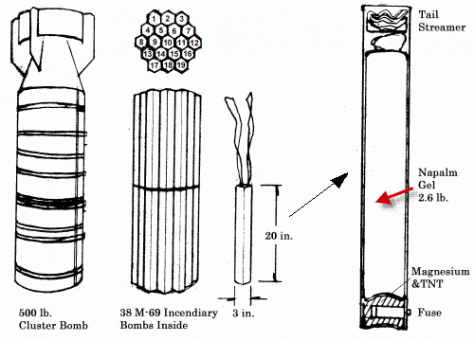
About 1145pm on that spring Friday night, an incendiary bomblet struck the roof of the Kodokan just to the east of the seat of Kano shihan in the Dai Dōjō (‘Great Dōjō’, the largest of several in the building). It was probably an M65, a 6 pound (2.7 kg) napalm bomblet released from a 500 pound (228 kg) cluster bomb, one of scores dropped by a B29 Superfortress heavy bomber from about 2500 ft altitude, and the bomblet probably penetrated partway through the roof.

 The previous high altitude, conventional bombing campaign against Japan had been considered ineffective, and the bombers were ordered to fly at very low altitudes to dispense their new fire bombs, despite much heavier losses to Japanese antiaircraft fire and interceptor fighter attacks than the previous high altitude attacks.

M69 incendiary bomb
Above is a sketch of the M69 Incendiary Bomb – similar to the smaller M65 used more often in the European theater.

1 to 3 seconds after impact with the roof, the bomblet fuzed a phosphorous bursting charge that splattered flaming jellied gasoline napalm over the Kodokan roof.

Some of the burning jellied gasoline napalm burned through the roof, setting fire to the large, elaborate 神棚 kamidana Shintō ‘god shelf’ that Kano shihan had installed on the front wall of the Dai Dōjō. Fire reached the tatami below, burning around 70 mats; soon the fire outside the building burned together with the fire inside to threaten the entire structure.


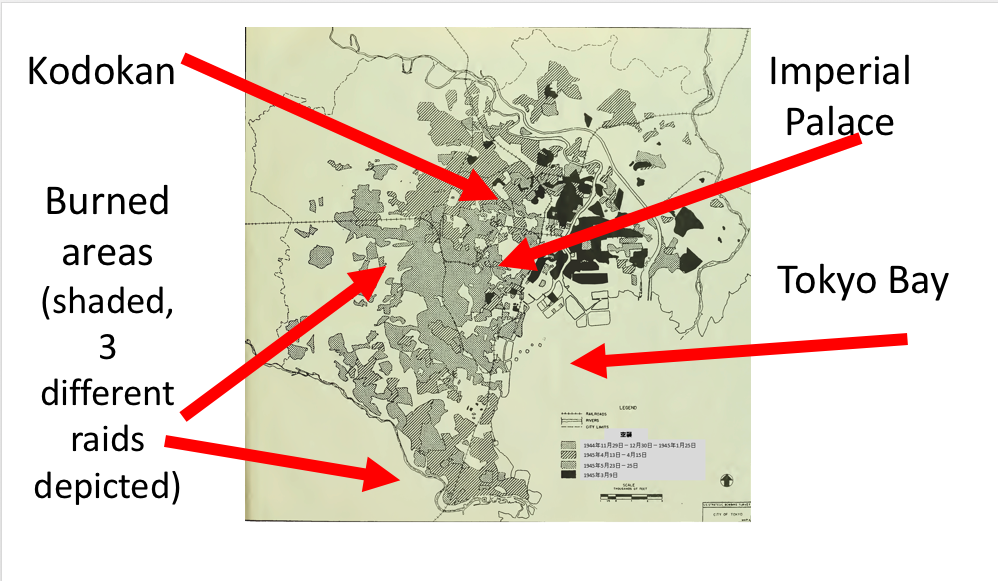
A fire truck team arrived but low water pressure hampered their efforts. Then, the night watch and local couples cheered on the local tonari gumi neighborhood association, which used Kodokan hoses and buckets to assist the fire truck, putting the Kodokan fire out, but much of the neighborhood was destroyed. Almost 3500 people died and over 170,000 buildings were destroyed that single night raid.

Screen Shot 2020-01-13 at 17.48.49
The map of Tokyo above was adopted from the US Army Air Corps Strategic Bombing Survey,
a huge postwar study of the effectiveness of the bombing campaign against Japan.

Kodokan head Rear Admiral Nangō Jirō, Kano shihan’s nephew, was determined to renew training. He housed local refugees whose homes had been burned down in the undamaged portion of the Dai Dōjō, but had the walls of the rooms near the third floor research dōjō knocked down to enlarge it; regular practice resumed on the 16th.

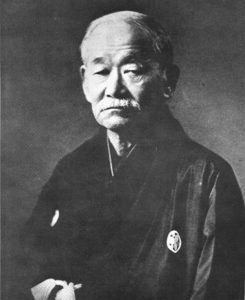
Jiro_Nango_Wiki
Imperial Navy Rear Admiral (Retired) Nangō Jirō,
the second Kodokan kanchō (institute head) and Kanō’s nephew
(Photo above from Wiki Commons, probably taken from a Japanese newspaper interview after the death of his second son in World War II. Story to be related later.)

The Dai Dōjō was repaired by the end of 1945 and was used for the training 寒稽古 kangeiko ‘cold weather training’ traditional in the new year of 1946.

NOTES:

* 全日本柔道連盟 Zen Nihon Jūdō Renmei All Japan Judo Federation history cites a date that does not match US Army Air Corps records of the raid dates; this history uses US military record dates when available. http://www.judo.or.jp  )

Lance Gatling
Author / Lecturer
Email at Contact@kanochronicles.com to comment or sign up below to get updates via email.

The Kanō Chronicles® – The Untold Story of Modern Japan


The Kanō Chronicles: The Untold History of Modern Japan® (嘉納歴代史:知らず近代日本史®) is the result of over 15 years of research into the life and times of Kanō Jigorō, 嘉納治五郎 (1860-1938), the founder of jûdô 柔道. In traditional jūdō texts and by today’s jūdōka 柔道家 (judo practitioners) he is normally addressed as ‘Kano shihan’ 師範 (Master Kano).*

No English or Japanese language biographies of Kano shihan capture the complexity of the man and his times. Even the best Japanese biographies are often narrow, typically focused on Kano’s jūdō, education, sports, or Olympic activities, or some combination thereof. There are exceptions, but they are rare and difficult to digest, even for native Japanese, and have escaped the attention of Western researchers.

Context is important, and detailed historical context is not part of Western biographies of Kano. One example can be seen below, in a rare English explanation by Kano shihan of the ‘True Spirit of Judo’.

When I was still young, I learned various types of “jujitsu”.** However, I found it difficult to discover the fundamental principles that decide as to which is the correct method because the teaching of each type was different. Thereupon, in order that I might find out the fundamental principle somehow or other, I began to study seriously. And, in the course of time, I was able to succeed in discovering it. What is this fundamental principle? It is to let our spirit and bodies work most effectively in order to accomplish our purpose, whenever we wish to throw others down, or cut, push, or kick others.

— Kano Jigoro, ‘True Spirit of Judo’, 1938

Rather than the ‘true spirit of jūdō’, a more complete context of the article reveals this to be only the lowest, simplest definition of jūdō espoused by Kanō shihan, meant only as the beginning of a much more complex discussion. As the rest of his discussion is thought not pertinent to today’s sports judo, it is typically discarded, thus lost to generations of judoka who are left with the notion that the epitome of his philosophy is physically controlling your opponent effectively.

Nothing could be further from the truth.

The Kanō Chronicles™ provides the history of Kanō shihan in the context of his times. He lived in a unique period of history, namely the development of Japan from an isolated, feudal backwater to one of the largest empires in history. His patrons, peers, and pupils included princes, prime ministers, politicians, philosophers, prophets, priests, political puppet masters, puppeteers, paupers, oligarchs, generals, admirals, academics, assassins, the assassinated, mandarins, revolutionaries, counterrevolutionaries, reactionaries, samurai, spies, spy masters, sumotori, strike breakers, chancellors, commoners, Christians, Chinese, Confucianists, Communists, women and Class A war criminals.

Kanō shihan personally participated in the initial formation and subsequent reforms of Japan’s education, language, sports, ethics, teacher and moral training, indeed the development and dissemination of its very culture. He thus left an indelible mark on the nation, indeed much of the Empire through the education of thousands of teachers, judoka and their millions of students.

********

* In keeping with the tradition, Japanese names are given in the order LastName FirstName. Note that in the era under study, Japanese often changed their first / given names in recognition of phases or changes in their lives; becoming an adult, reaching 60 years of age, or at any age to designate some eventful political or personal event.  Sometimes, frequently; sometimes, in accordance with the stages of life, or simply whimsically.  Some phases were chronological: 50, 60, 70, or 80 years old. Nicknames or pen names if known are given in single quotes, ala ‘Konan’, Kano shihan’s penname for calligraphy until his 60th birthday.

** The transliteration of Japanese into Western characters has changed over more than 100 years of use to settle on the current system. This site and associated works use older, nonstandard terms such as jujitsu, jiujutsu, jiudo, Kodokwan, etc. only in direct quotations. Today the rendering of these Japanese terms in Roman letters is unequivocal and universal; judo, jujutsu, Kodokan, etc.

Lance Gatling
Author / Lecturer
The Kanō Chronicles
Tokyo, Japan
Contact@kanochronicles.com – please send a note to give us feedback.
Thank you!